1931
Manhattan: 42nd Street (East) - Lexington Avenue
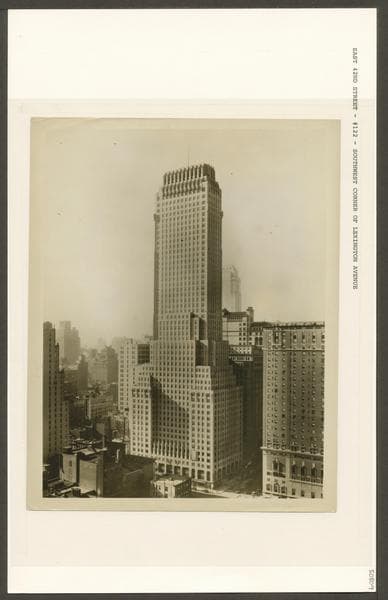
For the first time in the history of photography, the principle so successfully used in serial camera work of compositing into a single illustration a series of pictures covering one subject, has been applied to a vertical object over 1,000 feet in height. Mal Walton, widely known New York Photographer, has produced this unusual illustration of the 1040 foot Chrysler building at Lexington Avenue and 42nd Street in New York. Many weeks of tireless experimental work were necessary. Perspectives had to be scaled and rescaled and control points accurately established before the actual work of taking pictures could begin. Inability to get far enough away from the Chrysler Building to obtain a single picture of the entire building front from sidewalk to spire made the question of correct perspective in the production of this work a very disconcerting factor. Structures of various heights surrounding the building stood in the way of securing one photograph that would show the elevation of the building which is on Lexington Avenue. To make a series of pictures which when composited would bring out the natural perspective of a single picture taken from one point distant enough to include the entire building, it was necessary to establish two fixed controls or focal points, one at a ground point and the other at a point in the spire. Definitely to locate the spire point of control, the Goodyear Tire and Rubber Company placed its blimp, the Mayflower, at the disposal of Mr. Walton and his associates. After a series of reconnoitering flights around the building the control point was established and the necessary photographs made from the blimp while poised in mid-air at various levels below the top of the spire of the building. The ground point of control was determined with much less difficulty and the numerous photos made from neighboring buildings at carefully calculated angles extended from the sidewalk to the lowest level of the blimp-made pictures. Beyond the point of being a photographic problem, as Mr. Walton points out, this illustration of the Chrysler Building involved intricate engineering problems. To Mr. Walton is due full credit for conceiving and executing the airflight and ground pictures into a perfect mosaic-composite, which bids fair to be an epoch in the history of photography. After such a perfect first effort at pioneering a brand new style of photography doubtless there will be many occasions to use it as a sense of obtaining heretofore impossible actual illustrations of many of the new skyscrapers which are too completely hidden by other buildings to be photographed by a single exposure.
Photo from the New York Public Library - Milstein Collection